 1#include <cstdio>
 2#include <iostream>
 3#include <cmath>
 4using namespace std;
 5long long d1,d2,d3;
 6int main()
 7{
 8cin>>d1>>d2>>d3;
 9long long ans = 999999999999;
10ans = min(ans,d1+d2+d3);
11ans = min (ans,d1*2+d2*2);
12ans = min (ans,d1*2+2*d3);
13ans = min(ans,d2*2+2*d3);
14cout<<ans<<endl;
15return 0;
16}
time limit per test
1 second
memory limit per test
256 megabytes
input
standard input
output
standard output
Today Patrick waits for a visit from his friend Spongebob. To prepare for the visit, Patrick needs to buy some goodies in two stores located near his house. There is a _d_1 meter long road between his house and the first shop and a _d_2 meter long road between his house and the second shop. Also, there is a road of length _d_3 directly connecting these two shops to each other. Help Patrick calculate the minimum distance that he needs to walk in order to go to both shops and return to his house.
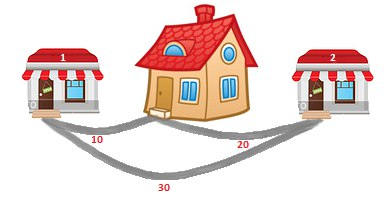
Patrick always starts at his house. He should visit both shops moving only along the three existing roads and return back to his house. He doesn’t mind visiting the same shop or passing the same road multiple times. The only goal is to minimize the total distance traveled.
Input
The first line of the input contains three integers _d_1, _d_2, _d_3 (1 ≤ _d_1, _d_2, _d_3 ≤ 108) – the lengths of the paths.
- _d_1 is the length of the path connecting Patrick’s house and the first shop;
- _d_2 is the length of the path connecting Patrick’s house and the second shop;
- _d_3 is the length of the path connecting both shops.
Output
Print the minimum distance that Patrick will have to walk in order to visit both shops and return to his house.
Sample test(s)
input
10 20 30
output
60
input
1 1 5
output
4
Note
The first sample is shown on the picture in the problem statement. One of the optimal routes is: house first shop second shop house.
In the second sample one of the optimal routes is: house first shop house second shop house.
time limit per test
1 second
memory limit per test
256 megabytes
input
standard input
output
standard output
Today Patrick waits for a visit from his friend Spongebob. To prepare for the visit, Patrick needs to buy some goodies in two stores located near his house. There is a _d_1 meter long road between his house and the first shop and a _d_2 meter long road between his house and the second shop. Also, there is a road of length _d_3 directly connecting these two shops to each other. Help Patrick calculate the minimum distance that he needs to walk in order to go to both shops and return to his house.
Patrick always starts at his house. He should visit both shops moving only along the three existing roads and return back to his house. He doesn’t mind visiting the same shop or passing the same road multiple times. The only goal is to minimize the total distance traveled.
Input
The first line of the input contains three integers _d_1, _d_2, _d_3 (1 ≤ _d_1, _d_2, _d_3 ≤ 108) – the lengths of the paths.
- _d_1 is the length of the path connecting Patrick’s house and the first shop;
- _d_2 is the length of the path connecting Patrick’s house and the second shop;
- _d_3 is the length of the path connecting both shops.
Output
Print the minimum distance that Patrick will have to walk in order to visit both shops and return to his house.
Sample test(s)
input
10 20 30
output
60
input
1 1 5
output
4
Note
The first sample is shown on the picture in the problem statement. One of the optimal routes is: house first shop second shop house.
In the second sample one of the optimal routes is: house first shop house second shop house.
水题。