Net 基本介绍#
网络通过组合与自动微分,共同定义一个函数及其梯度。
网络是由一些 Layer 组成的 DAG,也就是有向无环图,在 caffe 中通常由 prototxt 定义。
比如
 1name: "LogReg"
 2layer {
 3  name: "mnist"
 4  type: "Data"
 5  top: "data"
 6  top: "label"
 7  data_param {
 8    source: "input_leveldb"
 9    batch_size: 64
10  }
11}
12layer {
13  name: "ip"
14  type: "InnerProduct"
15  bottom: "data"
16  top: "ip"
17  inner_product_param {
18    num_output: 2
19  }
20}
21layer {
22  name: "loss"
23  type: "SoftmaxWithLoss"
24  bottom: "ip"
25  bottom: "label"
26  top: "loss"
27}
定义了
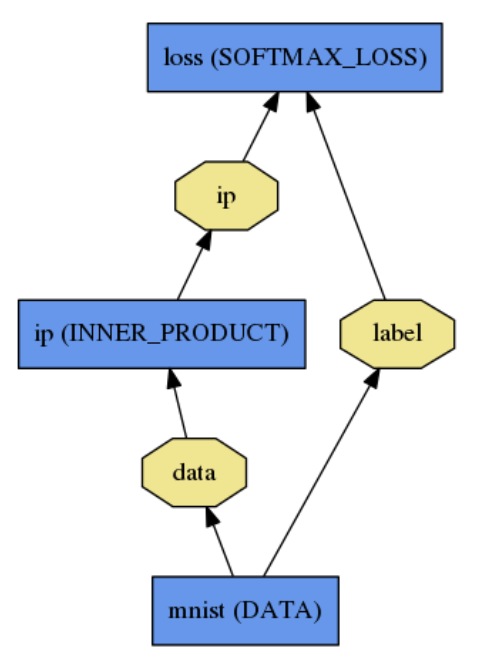
值得强调的是,caffe 中网络结构的定义与实现是无关的,这点比 pytorch 之类的深度学习框架不知高到哪里去了,也是 caffe 作为部署端事实标准的重要原因。
Net 实现细节#
我们先看下NetParameter的proto
 1
 2    message NetParameter {
 3      optional string name = 1; // consider giving the network a name
 4      // DEPRECATED. See InputParameter. The input blobs to the network.
 5      repeated string input = 3;
 6      // DEPRECATED. See InputParameter. The shape of the input blobs.
 7      repeated BlobShape input_shape = 8;
 8
 9      // 4D input dimensions -- deprecated.  Use "input_shape" instead.
10      // If specified, for each input blob there should be four
11      // values specifying the num, channels, height and width of the input blob.
12      // Thus, there should be a total of (4 * #input) numbers.
13      repeated int32 input_dim = 4;
14
15      // Whether the network will force every layer to carry out backward operation.
16      // If set False, then whether to carry out backward is determined
17      // automatically according to the net structure and learning rates.
18      optional bool force_backward = 5 [default = false];
19      // The current "state" of the network, including the phase, level, and stage.
20      // Some layers may be included/excluded depending on this state and the states
21      // specified in the layers' include and exclude fields.
22      optional NetState state = 6;
23
24      // Print debugging information about results while running Net::Forward,
25      // Net::Backward, and Net::Update.
26      optional bool debug_info = 7 [default = false];
27
28      // The layers that make up the net.  Each of their configurations, including
29      // connectivity and behavior, is specified as a LayerParameter.
30      repeated LayerParameter layer = 100;  // ID 100 so layers are printed last.
31
32      // DEPRECATED: use 'layer' instead.
33      repeated V1LayerParameter layers = 2;
34    }
都很好理解,除了 NetState,不知道是个什么东西……
继续往下看,看到和NetState有关的两个proto定义如下:
 1
 2message NetState {
 3  optional Phase phase = 1 [default = TEST];
 4  optional int32 level = 2 [default = 0];
 5  repeated string stage = 3;
 6}
 7
 8message NetStateRule {
 9  // Set phase to require the NetState have a particular phase (TRAIN or TEST)
10  // to meet this rule.
11  optional Phase phase = 1;
12
13  // Set the minimum and/or maximum levels in which the layer should be used.
14  // Leave undefined to meet the rule regardless of level.
15  optional int32 min_level = 2;
16  optional int32 max_level = 3;
17
18  // Customizable sets of stages to include or exclude.
19  // The net must have ALL of the specified stages and NONE of the specified
20  // "not_stage"s to meet the rule.
21  // (Use multiple NetStateRules to specify conjunctions of stages.)
22  repeated string stage = 4;
23  repeated string not_stage = 5;
24}
参考 [Discussion] How to specify all-in-one networks #3864 得知,这些参数的主要目的是为了解决部署和训练时需要多个 prototxt 的问题。
实际上,部署和训练用的 prototxt 可能大部分都是一样的,只不过是输入、输出以及少部分 layer 有些差别。如果分为多个文件,带来的问题就是:如果要修改一些共同的 layer,就需要修改两次。
于是可以通过这些参数来控制网络结构,使得部署和训练使用相同的 prototxt,得到一个 “all-in-one network”。
接下来值得看的是网络的构建部分。
对于一个 Net,会顺序构建每个 Layer。
对于每个 Layer,大致分为 AppendTop、AppendBottom、AppendParam 三部分,我们重点关注前两部分。
详细代码
 1// Helper for Net::Init: add a new bottom blob to the net.
 2template <typename Dtype>
 3int Net<Dtype>::AppendBottom(const NetParameter& param, const int layer_id,
 4    const int bottom_id, set<string>* available_blobs,
 5    map<string, int>* blob_name_to_idx) {
 6  const LayerParameter& layer_param = param.layer(layer_id);
 7  const string& blob_name = layer_param.bottom(bottom_id);
 8  if (available_blobs->find(blob_name) == available_blobs->end()) {
 9    LOG(FATAL) << "Unknown bottom blob '" << blob_name << "' (layer '"
10               << layer_param.name() << "', bottom index " << bottom_id << ")";
11  }
12  const int blob_id = (*blob_name_to_idx)[blob_name];
13  LOG_IF(INFO, Caffe::root_solver())
14      << layer_names_[layer_id] << " <- " << blob_name;
15  bottom_vecs_[layer_id].push_back(blobs_[blob_id].get());
16  bottom_id_vecs_[layer_id].push_back(blob_id);
17  //  ??? 怎么就erase了,一个top后面可以接多个layer的啊
18  available_blobs->erase(blob_name);
19  bool need_backward = blob_need_backward_[blob_id];
20  // Check if the backpropagation on bottom_id should be skipped
21  if (layer_param.propagate_down_size() > 0) {
22    need_backward = layer_param.propagate_down(bottom_id);
23  }
24  bottom_need_backward_[layer_id].push_back(need_backward);
25  return blob_id;
26}
27
28
29
30// Helper for Net::Init: add a new top blob to the net.
31template <typename Dtype>
32void Net<Dtype>::AppendTop(const NetParameter& param, const int layer_id,
33                           const int top_id, set<string>* available_blobs,
34                           map<string, int>* blob_name_to_idx) {
35  shared_ptr<LayerParameter> layer_param(
36      new LayerParameter(param.layer(layer_id)));
37  const string& blob_name = (layer_param->top_size() > top_id) ?
38      layer_param->top(top_id) : "(automatic)";
39  // Check if we are doing in-place computation
40  if (blob_name_to_idx && layer_param->bottom_size() > top_id &&
41      blob_name == layer_param->bottom(top_id)) {
42    // In-place computation
43    LOG_IF(INFO, Caffe::root_solver())
44        << layer_param->name() << " -> " << blob_name << " (in-place)";
45    top_vecs_[layer_id].push_back(blobs_[(*blob_name_to_idx)[blob_name]].get());
46    top_id_vecs_[layer_id].push_back((*blob_name_to_idx)[blob_name]);
47  } else if (blob_name_to_idx &&
48             blob_name_to_idx->find(blob_name) != blob_name_to_idx->end()) {
49    // If we are not doing in-place computation but have duplicated blobs,
50    // raise an error.
51    LOG(FATAL) << "Top blob '" << blob_name
52               << "' produced by multiple sources.";
53  } else {
54    // Normal output.
55    if (Caffe::root_solver()) {
56      LOG(INFO) << layer_param->name() << " -> " << blob_name;
57    }
58    shared_ptr<Blob<Dtype> > blob_pointer(new Blob<Dtype>());
59    const int blob_id = blobs_.size();
60    //  先取blob_id,再push_back 说明blob_id是从0开始递增的整数.
61    //  blob_id都是在appendTop时定义的
62    blobs_.push_back(blob_pointer);
63    blob_names_.push_back(blob_name);
64    blob_need_backward_.push_back(false);
65    if (blob_name_to_idx) { (*blob_name_to_idx)[blob_name] = blob_id; }
66    top_id_vecs_[layer_id].push_back(blob_id);
67    top_vecs_[layer_id].push_back(blob_pointer.get());
68  }
69  //  维护一个出现过的top blob集合,目的是判断后面所接layer的bottom blob名称的合法性
70  //  这里要判断 available_blobs 是否为NULL是因为,可能构造匿名的top blob,此时available_blobs
71  //  和 blob_name_to_idx 都会传NULL 值
72  if (available_blobs) { available_blobs->insert(blob_name); }
73}
代码比较好懂,解析部分见注释。 唯一值得注意的地方是 available_blobs 这部分的维护。在 AppendBottom 中:
1
2  //  ??? 怎么就erase了,一个top后面可以接多个layer的啊
3  available_blobs->erase(blob_name);
每次处理完一个 bottom 就从 available_blobs 去掉。
然而,一个 top blob 明明是可以输入给多个 layer 的…… ????? 不明白。
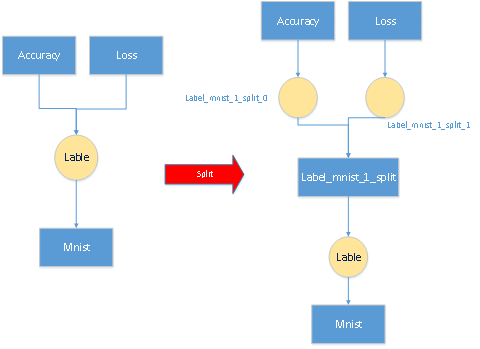
查阅资料看到 What does InsertSplit() / SplitLayer do? #767, 原来
// Create split layer for any input blobs used by other layers as bottom // blobs more than once.
对于被多个layer用作bottom的top blob,做了分身…
可以参考Net的网络层的构建(源码分析)