caffe中卷积运算的实现#
暴力实现的卷积大概是这样子的
 1
 2for w in 1..W
 3  for h in 1..H
 4    for x in 1..K
 5      for y in 1..K
 6        for m in 1..M
 7          for d in 1..D
 8            output(w, h, m) += input(w+x, h+y, d) * filter(m, x, y, d)
 9          end
10        end
11      end
12    end
13  end
14end
这种方式的效率显然很低,不意外地,caffe中并不是这样实现的.
注释里面说:
Caffe convolves by reduction to matrix multiplication. This achieves high-throughput and generality of input and filter dimensions but comes at the cost of memory for matrices. This makes use of efficiency in BLAS.
The input is “im2col” transformed to a channel K’ x H x W data matrix for multiplication with the N x K’ x H x W filter matrix to yield a N’ x H x W output matrix that is then “col2im” restored. K’ is the input channel * kernel height * kernel width dimension of the unrolled inputs so that the im2col matrix has a column for each input region to be filtered. col2im restores the output spatial structure by rolling up the output channel N’ columns of the output matrix.
大概意思是说把卷积运算转换成矩阵乘法,然后利用现有的矩阵乘法库来运算.
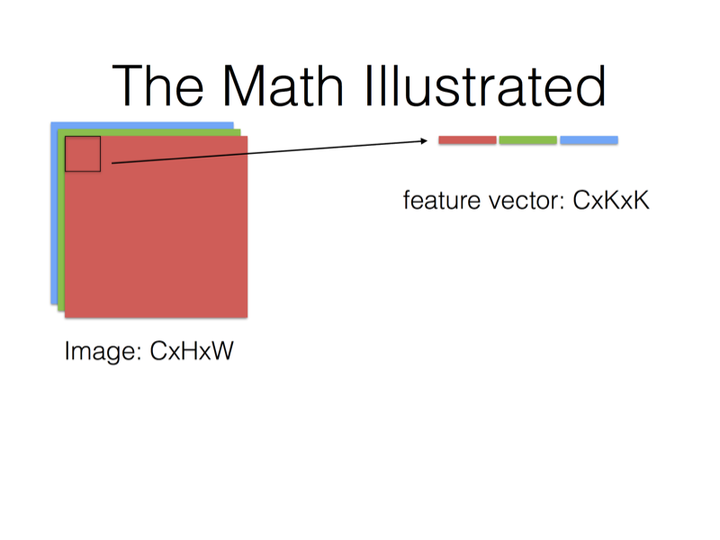
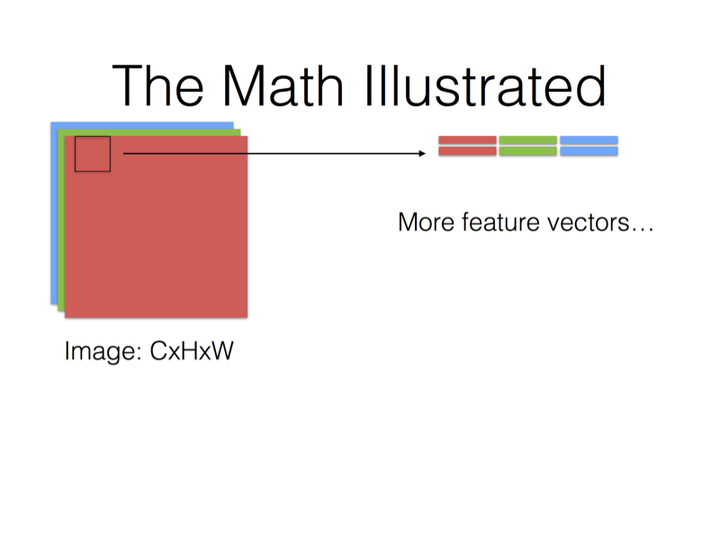
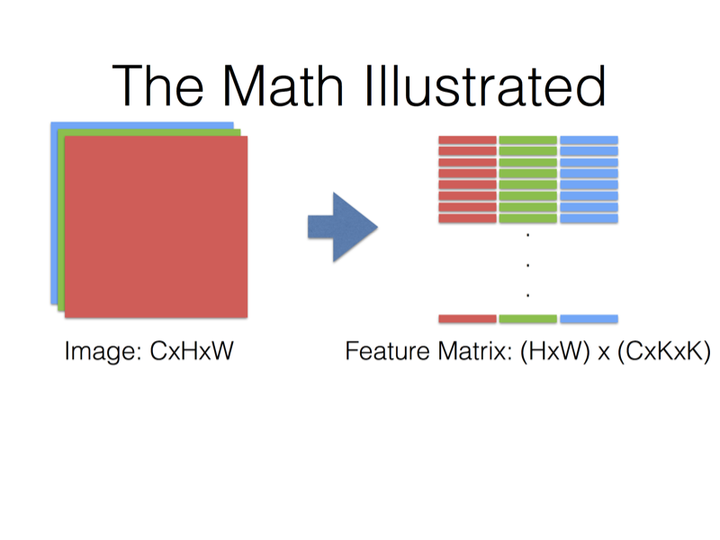
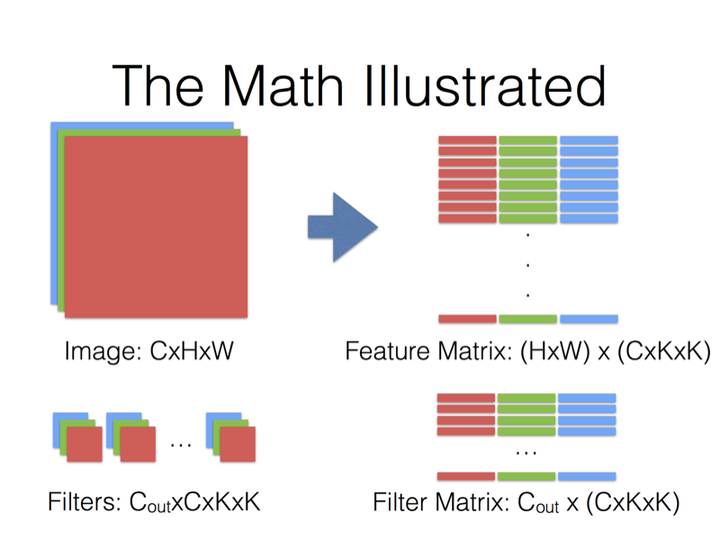
最后就是 Filter Matrix 乘以 Feature Matrix 的转置,得到输出矩阵 Cout x (H x W)
所以我觉得注释里 filter matrix 的尺寸说成是 “N*K’” 而不是 “N x K’ x H x W” 更容易让人理解一些?
需要注意的是,这里为了方便讨论,采用了让输入和输出的feature map的尺寸一致的设置.
caffe 代码中 src/caffe/util/im2col.cpp 里的 im2col 和 col2im,都是为了这个优化(指把卷积运算转换成矩阵乘法)。 这部分感觉过于 detail 了,不打算展开。
这里还有caffe作者对这个优化的思考 Convolution in Caffe: a memo
我觉得最值得我们学习的是,不要重复造轮子,先看要解决的问题有没有现成的实现,如果没有,那么能不能把我们要解决的问题转换成有现成实现的问题.
分析完这个运算感觉已经说完了. 我们看一下caffe proto
详细代码
 1
 2message ConvolutionParameter {
 3  optional uint32 num_output = 1; // The number of outputs for the layer
 4  optional bool bias_term = 2 [default = true]; // whether to have bias terms
 5
 6  // Pad, kernel size, and stride are all given as a single value for equal
 7  // dimensions in all spatial dimensions, or once per spatial dimension.
 8  repeated uint32 pad = 3; // The padding size; defaults to 0
 9  repeated uint32 kernel_size = 4; // The kernel size
10  repeated uint32 stride = 6; // The stride; defaults to 1
11  // Factor used to dilate the kernel, (implicitly) zero-filling the resulting
12  // holes. (Kernel dilation is sometimes referred to by its use in the
13  // algorithme à trous from Holschneider et al. 1987.)
14  repeated uint32 dilation = 18; // The dilation; defaults to 1
15
16  // For 2D convolution only, the *_h and *_w versions may also be used to
17  // specify both spatial dimensions.
18  optional uint32 pad_h = 9 [default = 0]; // The padding height (2D only)
19  optional uint32 pad_w = 10 [default = 0]; // The padding width (2D only)
20  optional uint32 kernel_h = 11; // The kernel height (2D only)
21  optional uint32 kernel_w = 12; // The kernel width (2D only)
22  optional uint32 stride_h = 13; // The stride height (2D only)
23  optional uint32 stride_w = 14; // The stride width (2D only)
24
25  optional uint32 group = 5 [default = 1]; // The group size for group conv
26
27  optional FillerParameter weight_filler = 7; // The filler for the weight
28  optional FillerParameter bias_filler = 8; // The filler for the bias
29  enum Engine {
30    DEFAULT = 0;
31    CAFFE = 1;
32    CUDNN = 2;
33  }
34  optional Engine engine = 15 [default = DEFAULT];
35
36  // The axis to interpret as "channels" when performing convolution.
37  // Preceding dimensions are treated as independent inputs;
38  // succeeding dimensions are treated as "spatial".
39  // With (N, C, H, W) inputs, and axis == 1 (the default), we perform
40  // N independent 2D convolutions, sliding C-channel (or (C/g)-channels, for
41  // groups g>1) filters across the spatial axes (H, W) of the input.
42  // With (N, C, D, H, W) inputs, and axis == 1, we perform
43  // N independent 3D convolutions, sliding (C/g)-channels
44  // filters across the spatial axes (D, H, W) of the input.
45  optional int32 axis = 16 [default = 1];
46
47  // Whether to force use of the general ND convolution, even if a specific
48  // implementation for blobs of the appropriate number of spatial dimensions
49  // is available. (Currently, there is only a 2D-specific convolution
50  // implementation; for input blobs with num_axes != 2, this option is
51  // ignored and the ND implementation will be used.)
52  optional bool force_nd_im2col = 17 [default = false];
53}
可以看到,里面有很多参数. 说明caffe是把很多种卷积放在一起实现的. 之后我们逐个分析一下.
各种卷积#
2d 卷积#
最最普通的一种
下面的图是一个 filter 的运算情况。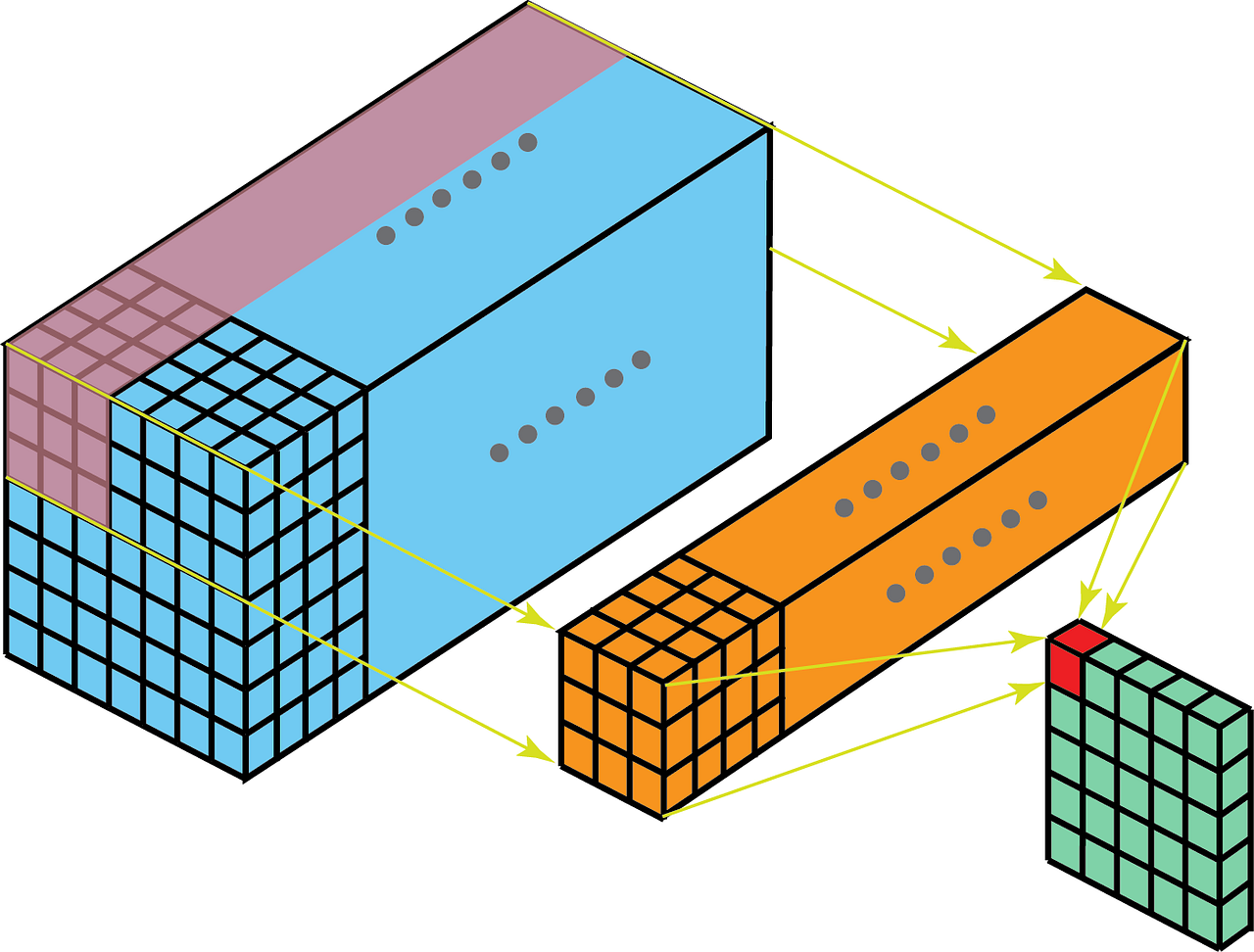
2d 可以理解成 filter 只在 height 和 width 两个方向移动
值得一提的是卷积的尺寸计算:
\[ \begin{cases} height_{out} &= (height_{in} - height_{kernel} + 2 * padding) ~ / ~ stride + 1\\[2ex] width_{out} &= (width_{in} - width_{kernel} + 2 * padding) ~ / ~ stride + 1 \end{cases} \]这里关于 padding 的尺寸还有两个特别有迷惑色彩的词:“valid padding” 和 “same padding”。 可以参考 What is the difference between ‘SAME’ and ‘VALID’ padding in tf.nn.max_pool of tensorflow?
- valid:不做任何 padding,只在 “valid” 的区域做卷积。如果 filter 的一部分超过了 feature map 的边界,就不做卷积。
- same:并不表示 input 和 output 的 size 相同(只在 stride 为 1 时成立),而是说如果 filter 超出了 feature map 的边界,自动做 padding。
3d 卷积#
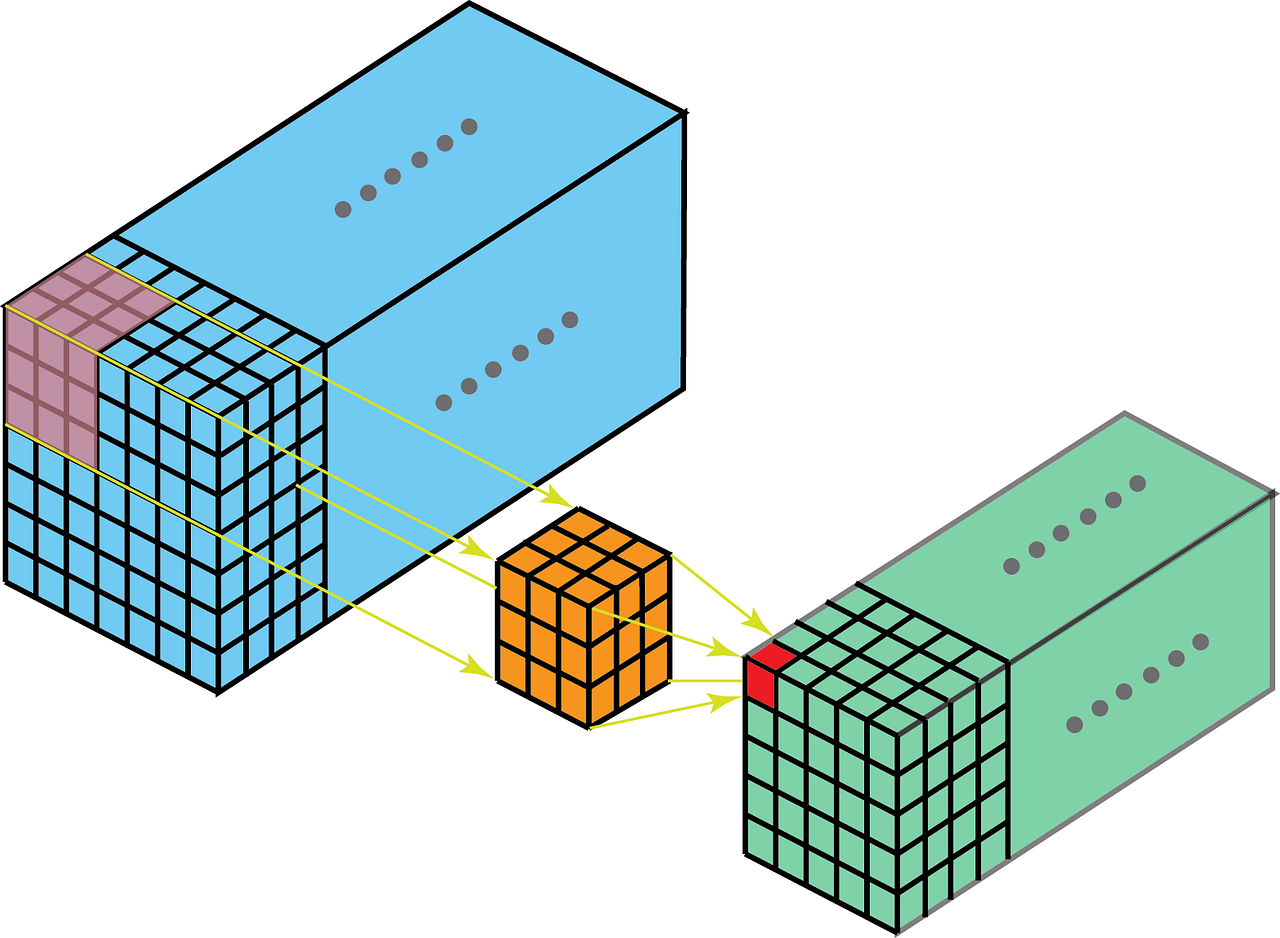
区别主要是 filter 的depth小于 input的depth. 因此在depth方向也可以移动.
1 x 1 卷积#
印象中应该是 Going Deeper with Convolutions中的inception module最先引入了1*1的卷积.
印象错误.. 不过至少算是让这种结构广为人知?
原因是inception module中计算量太大了,因此用1*1的卷积降低维度.
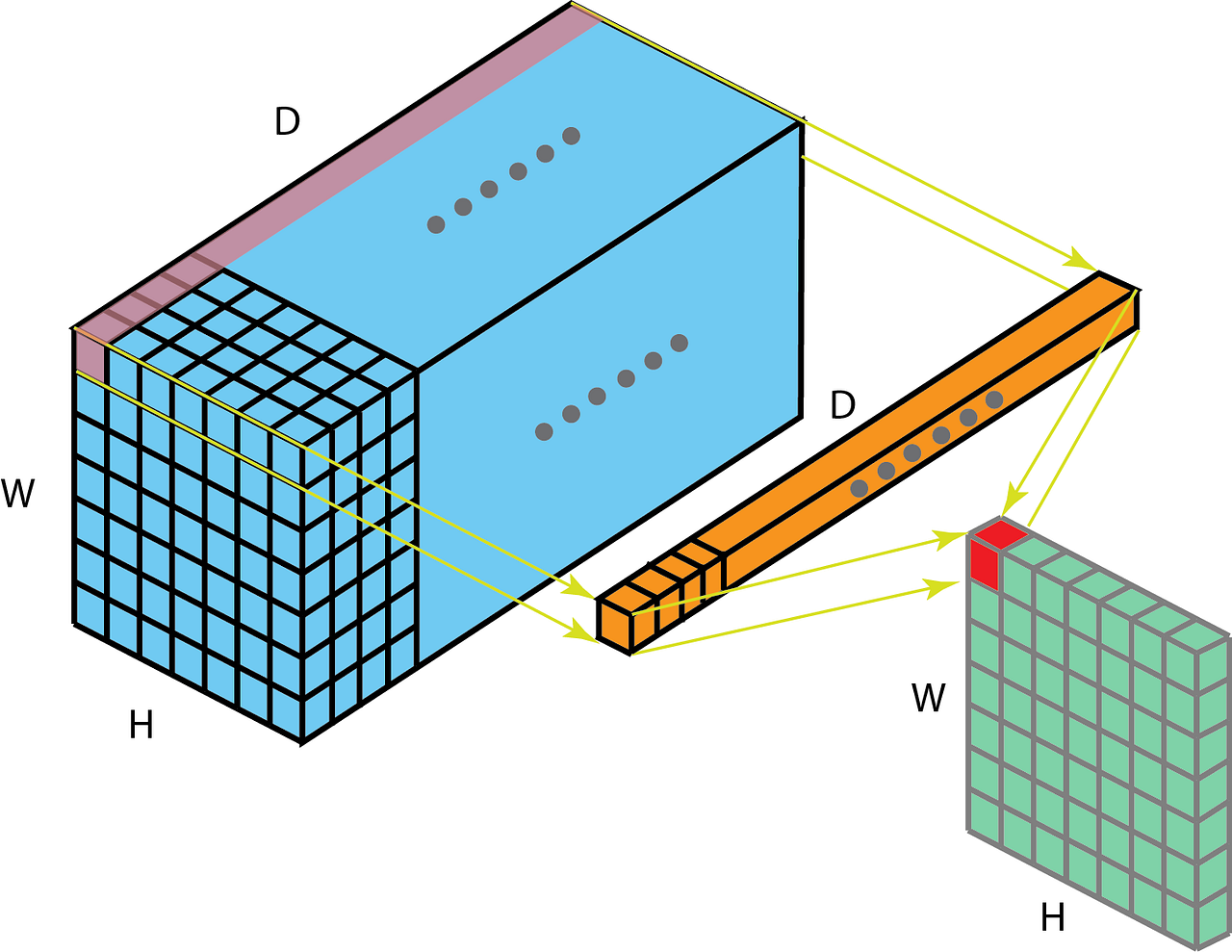
其实1*1的卷积本质上就是对不同channel的feature进行线性组合,只不过这种操作恰好可以通过一种1*1的卷积结构实现.
Transposed Convolution (Deconvolution)#
Transposed Convolution 其实是比较合适的叫法,但是人们也经常用"Deconvolution"来表示.
我们考虑一个 Semantic Segmentation 问题,需要做像素级别的分类.
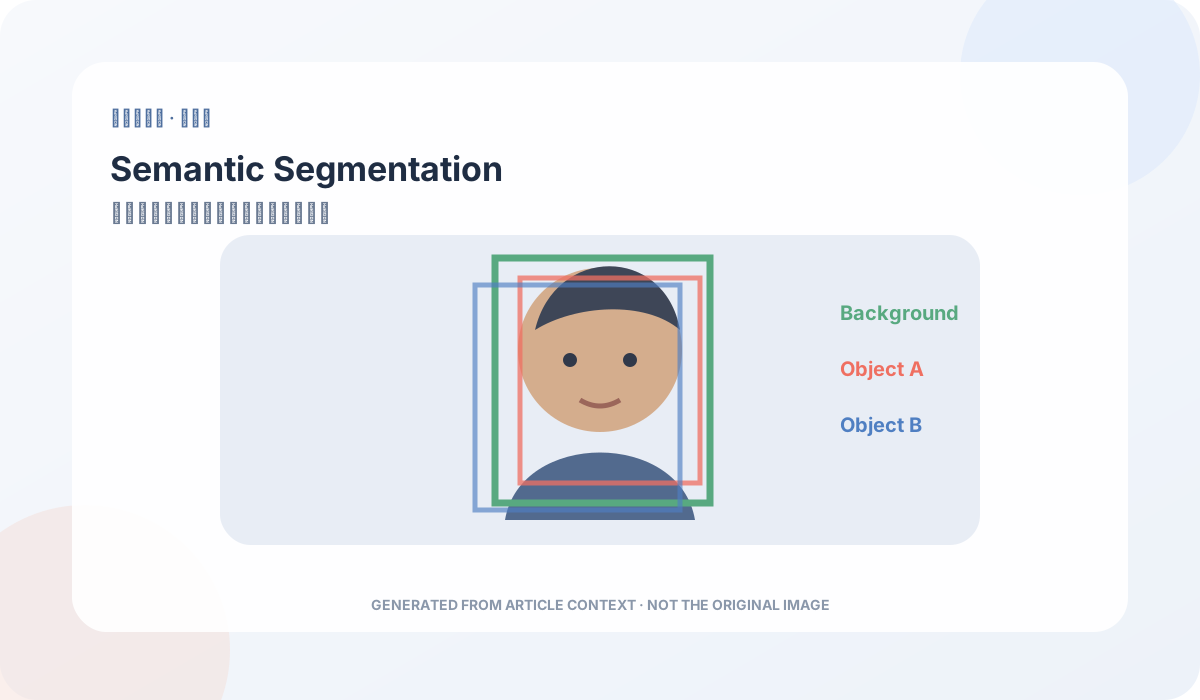
这样的问题在于计算代价比较大,一般的做法是在encoder阶段抽特征,downsample到一个合适的尺寸,然后在decoder阶段upsample到原图的尺寸.
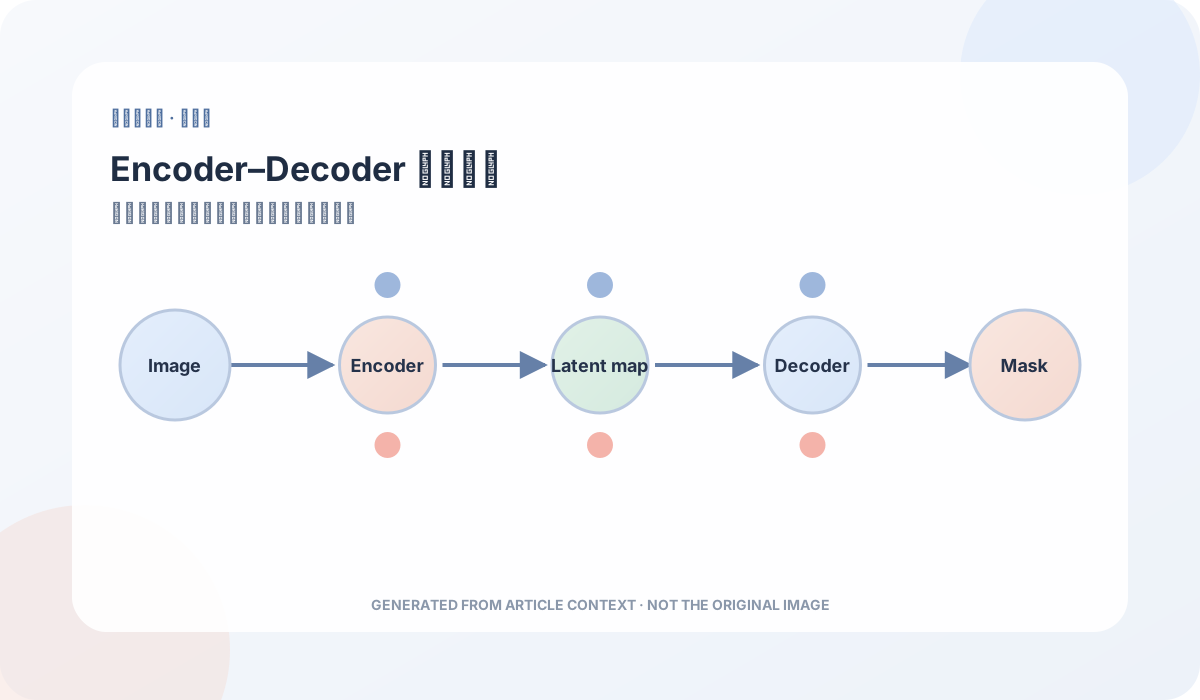
Transposed Convolution 就是一种做upsample的方式.
正常的卷积是feature map的每个结果是filter和input做点积得到的. Transposed Convolution 是 input表示了filter在feature map上对应位置的权重.
大概长这样:
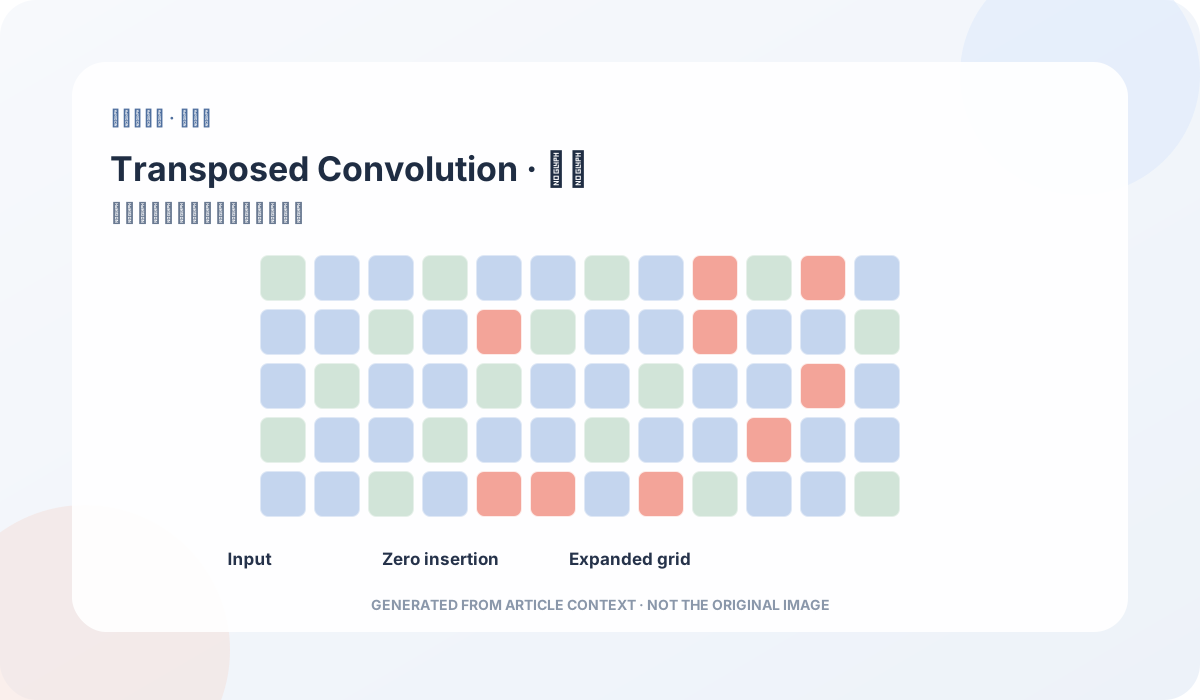
和这样:
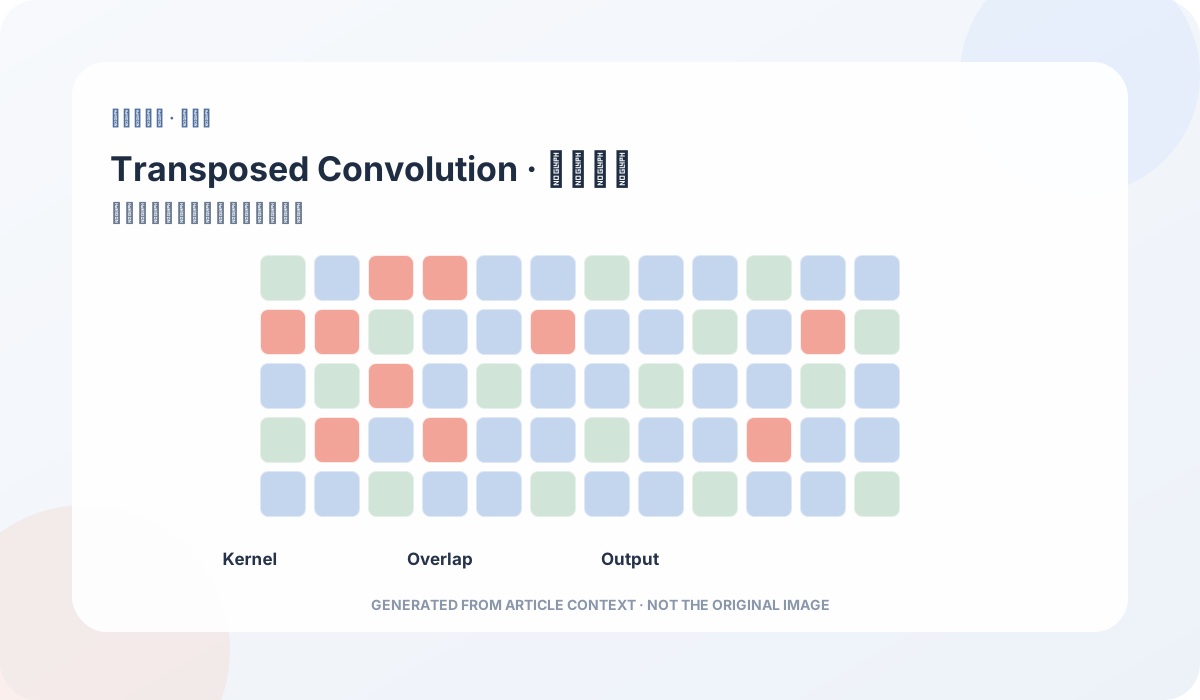
那么这个操作为啥叫"Transposed Convolution"呢 因为这个操作其实是把input feature map的矩阵做了转置,再做正常的卷积.
Dilated Convolution (空洞卷积)#
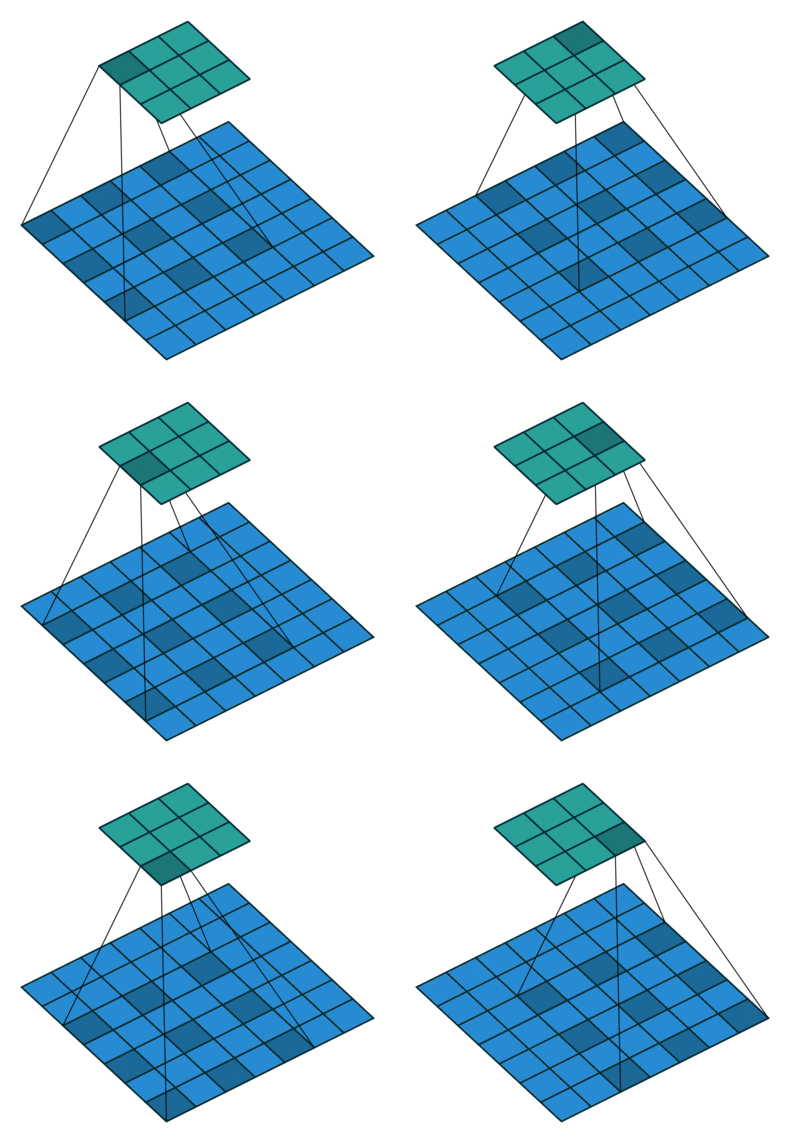
其中蓝色为输入的feature map,绿色会输出的feature map.
caffe的conv layer是直接支持这种结构的. 似乎是在 Semantic Segmentation 领域比较常见,在工作中没太接触过这种结构.
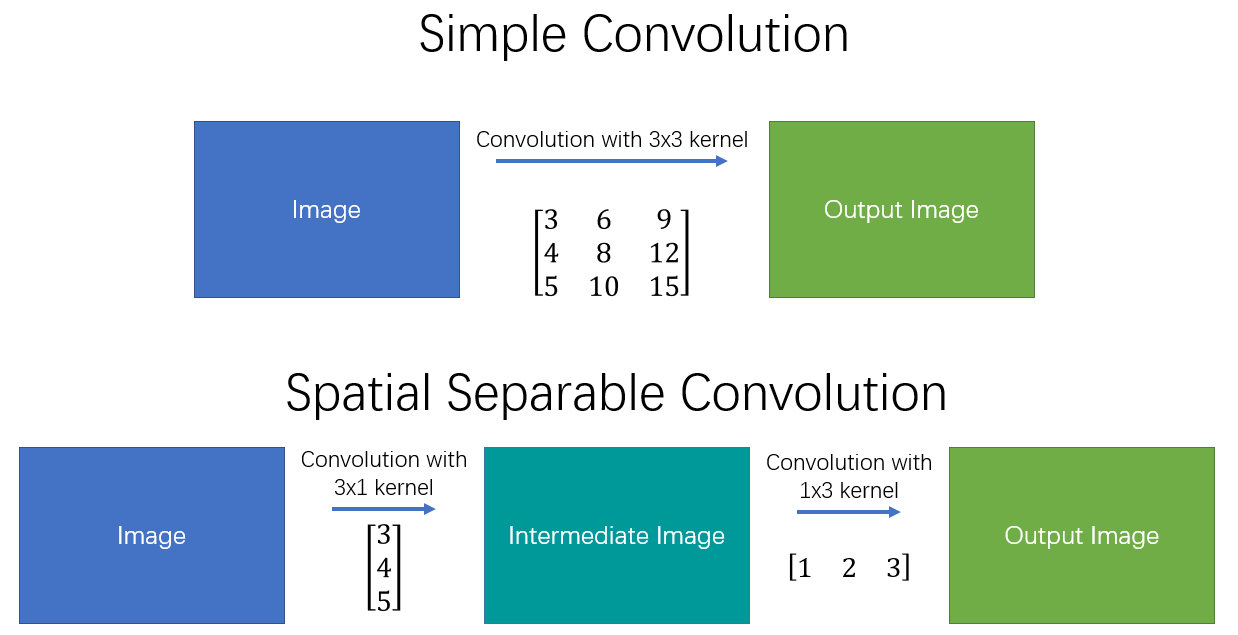
Spatially Separable Convolutions#
之前完全没有接触过的一种卷积,似乎主要用在移动端设备上的网络结构里,主要作用是减少卷积的参数量。
Grouped Convolution#
做鉴黄的同事提了新的需求,于是来看一下这种卷积。
主要作用是通过 group conv 替代一般的 conv 来降低参数量,具体来说参数量变成原来的 1/G,推导过程见下图:
截取自 Group Convolution分组卷积,以及Depthwise Convolution和Global Depthwise Convolution(虽然感觉 “feature map 的数量” 叫法怪怪的,一般不是把整个 depth 看做一个 feature map 吗?不过不影响)
主要思想是做卷积时把 N 个 Filters 分成 G 组,同时把输入的 feature map 也按照 depth 分成 G 组,每组 Filters 只和对应的 feature map 做卷积。
先看 G=2 的情况直观感受一下
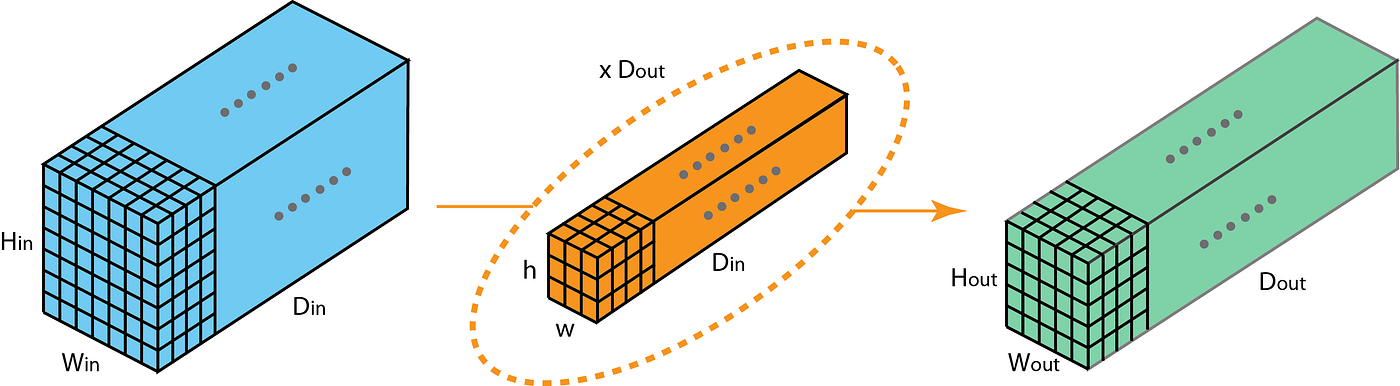
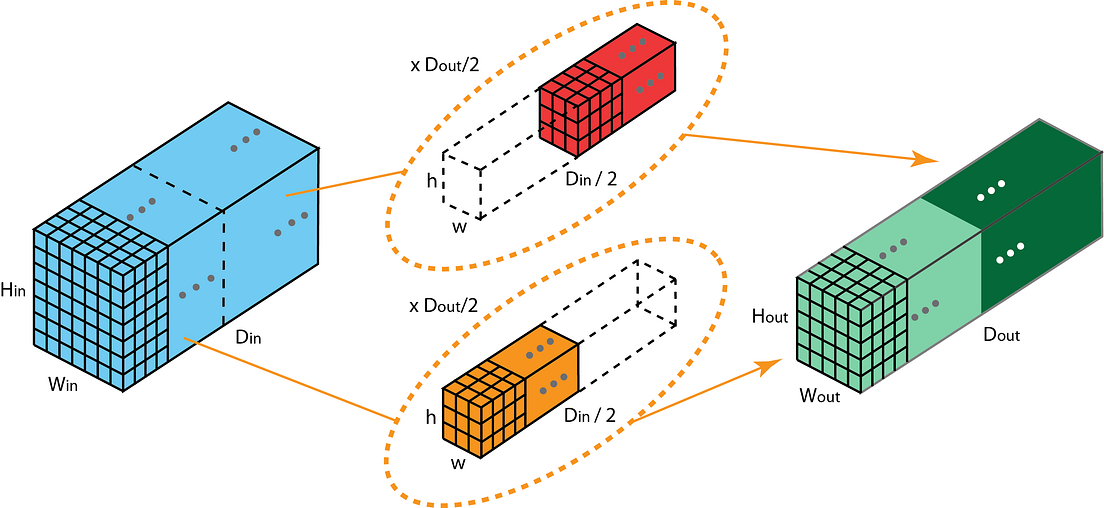
注意图上其实是单个filter的情况,filter的channel变成了一半,只和输入feature map的前一半或者后一半做卷积,然后只会得到一个二维的Wout*Hout的输出feature map. 然后每组的filter的数量也变成了分组前的一半,也就是N/2,加起来还是N.
再来看一个描述全部 filter 的图,这里 G=3
然后简单看一下 caffe 的实现,主要是看 base_conv_layer,它是 conv_layer 的基类,这里只挑和 group 有关的部分。
1
2  group_ = this->layer_param_.convolution_param().group();
3  CHECK_EQ(channels_ % group_, 0);
4  CHECK_EQ(num_output_ % group_, 0)
5      << "Number of output should be multiples of group.";
可以看出 group 数目必须能被 filter num 和 input feature channels 数整除。
 1
 2
 3template <typename Dtype>
 4void BaseConvolutionLayer<Dtype>::forward_cpu_gemm(const Dtype* input,
 5    const Dtype* weights, Dtype* output, bool skip_im2col) {
 6  const Dtype* col_buff = input;
 7  if (!is_1x1_) {
 8    if (!skip_im2col) {
 9      conv_im2col_cpu(input, col_buffer_.mutable_cpu_data());
10    }
11    col_buff = col_buffer_.cpu_data();
12  }
13  for (int g = 0; g < group_; ++g) {
14    caffe_cpu_gemm<Dtype>(CblasNoTrans, CblasNoTrans, conv_out_channels_ /
15        group_, conv_out_spatial_dim_, kernel_dim_,
16        (Dtype)1., weights + weight_offset_ * g, col_buff + col_offset_ * g,
17        (Dtype)0., output + output_offset_ * g);
18  }
19}
实现得也很朴素,就是一个 for 循环。group_ 参数默认为 1,为 1 时就是普通的卷积。